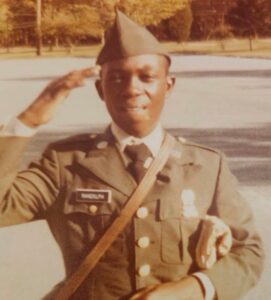


Tonight, We the People of the State of Florida executed U.S. Army Veteran Richard Barry Randolph (Malik Abdul-Sajjad) for the 1988 murder of Minnie Ruth McCollum. Tonight’s execution shows, with painful clarity, that the State of Florida does not believe in redemption. Or hope. And that it only believes that more violence is the solution.
Malik’s life was built on a lie. For nearly 60 years, Malik believed that his biological parents had abandoned him. But in 2022, newly released New York adoption records revealed the truth: his birth mother was a 17-year-old girl who gave birth to him in a home for unwed mothers. Just after his birth, her parents forced her to give up the curly-headed brown-eyed infant she named Barry. She believed he’d be given to loving parents who would give him the kind of stable life he deserved. She went on to be a successful international banker, and had a loving husband for decades. She never stopped wondering what happened to her son. She spent 50 years searching for him.
The files were finally opened in 2019 and she reunited with him in 2022. Malik’s birth mother was devastated to learn that instead of the better life she had envisioned for him, he had endured a childhood of chaos and cruelty. His adoptive father beat him with belts, broomsticks, and closed fists, sometimes locking him in dark closets for days. His adoptive mother battled alcoholism and severe mental illness, was hospitalized repeatedly for psychiatric care, and told him he was worthless. No one celebrated his birthdays. No one told him he was loved. The message he internalized was simple: he wasn’t wanted and he did not matter.
After graduating from high school, Malik sought a sense of belonging and structure by enlisting in the U.S. Army. He served our nation honorably, and yet the military could not and did not address his unhealed childhood trauma. He turned to drugs to cope with the pain he had carried since childhood, and that untreated addiction led directly to the tragic murder of Ms. McCollum.
But the lies and failures did not stop there. They continued at his death penalty trial. Malik was a Black man tried in rural Palatka for the killing of a white woman. A 20-foot Confederate monument stood on the lawn of the county courthouse, with an inscription on its base: “The principles for which they fought will live eternally.” His defense lawyer — also designated a “special sheriff’s deputy” — barely investigated the case. He put on a half-hearted penalty phase presentation, where he called only a single witness. He never bothered to learn about, let alone tell the jury about, the catastrophic abuse Malik suffered at the hands of his adoptive parents. As a result, the court falsely concluded in its sentencing order that Malik had been raised in a loving home.
Despite this paltry presentation, 4 of Malik’s jurors voted for a life sentence. In any other state in the nation Malik would not even be eligible for a death sentence.
Tossed aside and sent to death row, Malik was determined to make the best of the time that he had left. He converted to Islam. He has spent more than three decades studying his faith, mentoring younger men on death row, mediating conflicts, and maintaining a spotless disciplinary record. He has formed and maintained loving relationships with his families — both biological and adopted. This includes his brother who only learned of Malik’s existence a few weeks ago, and his birth mother, who turned 80 the same week his warrant was signed. When he called her to share the news with her, he lamented that instead of celebrating her birthday, she would be burying the curly-headed infant she had been forced to give away all those years ago. The infant she spent decades searching for.
Tonight’s premeditated killing is our 17th of this year. The 7th veteran Florida has executed in 2025 alone. Malik’s death brings no justice. We in no way diminish the profound suffering Ms. McCollum’s family has endured — their loss is heartbreaking, irrevocable, and deserving of our deepest grief.
But, in its prideful quest to be the deadliest state in the nation, Florida has created more victims. It has slammed the door on healing, hope, and redemption. Florida has mastered the cold mechanics of killing and shown no interest in anything beyond that function.
We have lost our way.
###
FADP is a Florida-based, statewide organization of individuals and groups working together to end the death penalty in Florida. Our network includes dozens of state and local groups and thousands of individual Floridians, including murder victims’ family members and other survivors of violent crime, law enforcement professionals, families of the incarcerated, and death row exonerees.